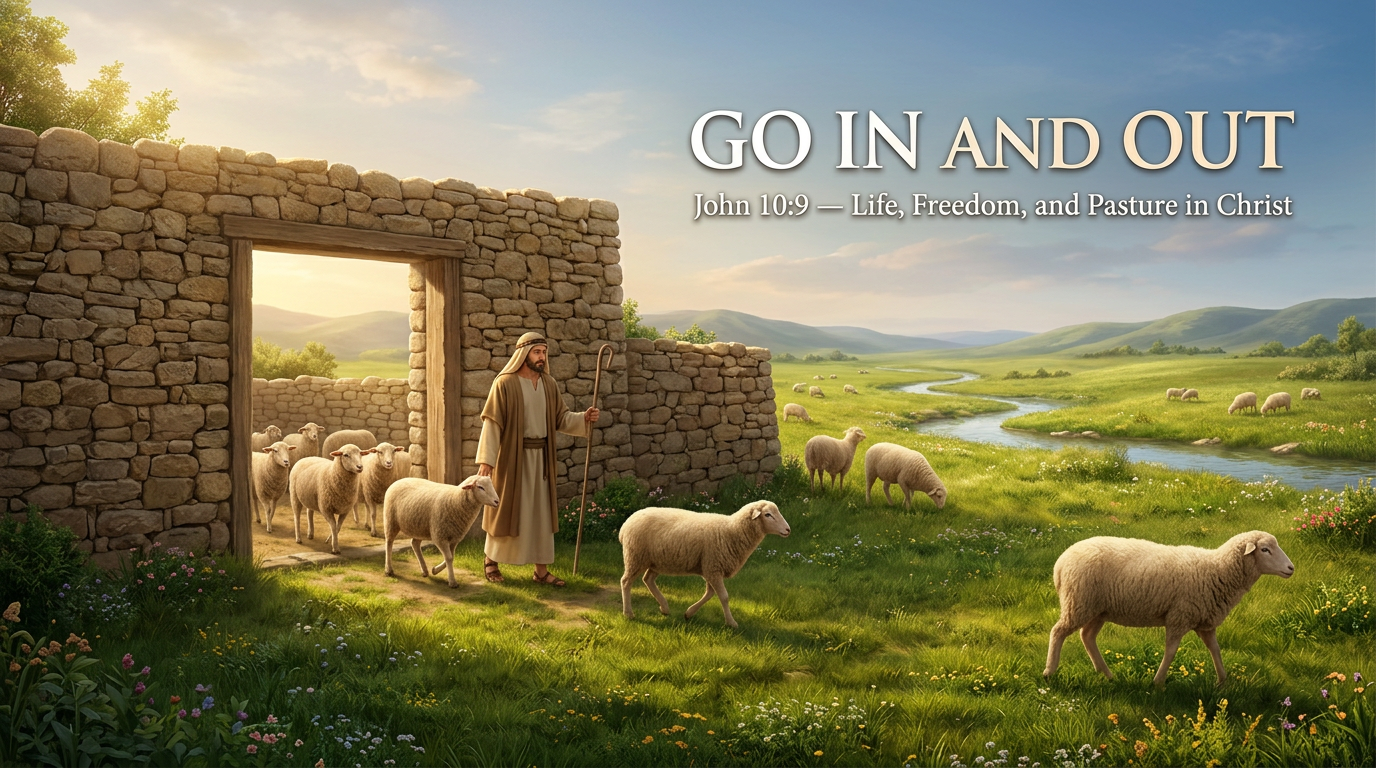
01 / THE DOOR
Jesus declares, "I am the door." His picture
is not merely of a destination but of access to life through
Himself. The sheep enter through the door and belong to the
Shepherd. Salvation is found in Christ, who brings His people
into the security and care of their relationship with God.
02 / IN AND OUT
Why does Jesus say that the sheep will "go in and out"?
If salvation were simply a matter of entering a permanent
heavenly enclosure, we might expect the sheep to remain
inside forever. But a sheepfold is not the same thing as a
pasture. The shepherd provides a place of safety while also
leading the sheep into the open land. The expression suggests
freedom of movement, not confinement or the repeated loss
of salvation.
03 / THE NEW CREATION
What if we consider this alongside the New Heavens and New
Earth? Revelation 21 describes the New Jerusalem coming
down out of heaven from God. Within a fulfilled-prophecy
understanding, these images can describe the new covenant
order established through Christ. Life in this new order is
not necessarily pictured as confinement to a heavenly
location. Rather, those who belong to Christ can live in
God's presence while continuing their lives in the world.
This is a theological connection between the passages,
not an explicit identification of the sheepfold with
the New Jerusalem.
04 / FINDING PASTURE
Jesus completes the promise with the words,
"and will find pasture." The image moves
beyond simply being protected to enjoying life and provision.
The Shepherd does not save His sheep merely to keep them
behind walls. He leads them to nourishment. In Christ,
the emphasis is on belonging, freedom, and the abundant
life He provides. The door opens into a life of relationship
with God, not a life of confinement.
05 / INSIDE AND OUTSIDE THE CITY
Revelation gives us another picture of life in relation to
God's city. Revelation 21:25 says that the gates of the New
Jerusalem will never be shut by day, and there will be no
night there. The open gates suggest continual access to the
city. Yet Revelation 22:14 speaks of entering the city
through its gates, while Revelation 22:15 describes those
who are outside. The imagery distinguishes between being
inside and outside the city, even as the invitation to enter
remains central to the vision. How might this relate to
Jesus' words in John 10:9, that His sheep will "go in and
out, and will find pasture"? Jesus describes movement through
Himself as the door, with the promise of salvation and
provision. Revelation portrays a city with open gates and
speaks of both entry and those outside. Read together within
a fulfilled-prophecy understanding, these passages invite
us to consider how the new covenant life established through
Christ provides access to God. We should not assume that
Revelation's people outside the city are necessarily the
same as Jesus' sheep going out to pasture. Rather, the
connection raises a deeper question: what does it mean to
have access to God's life, and what distinguishes those
who enter from those who remain outside?